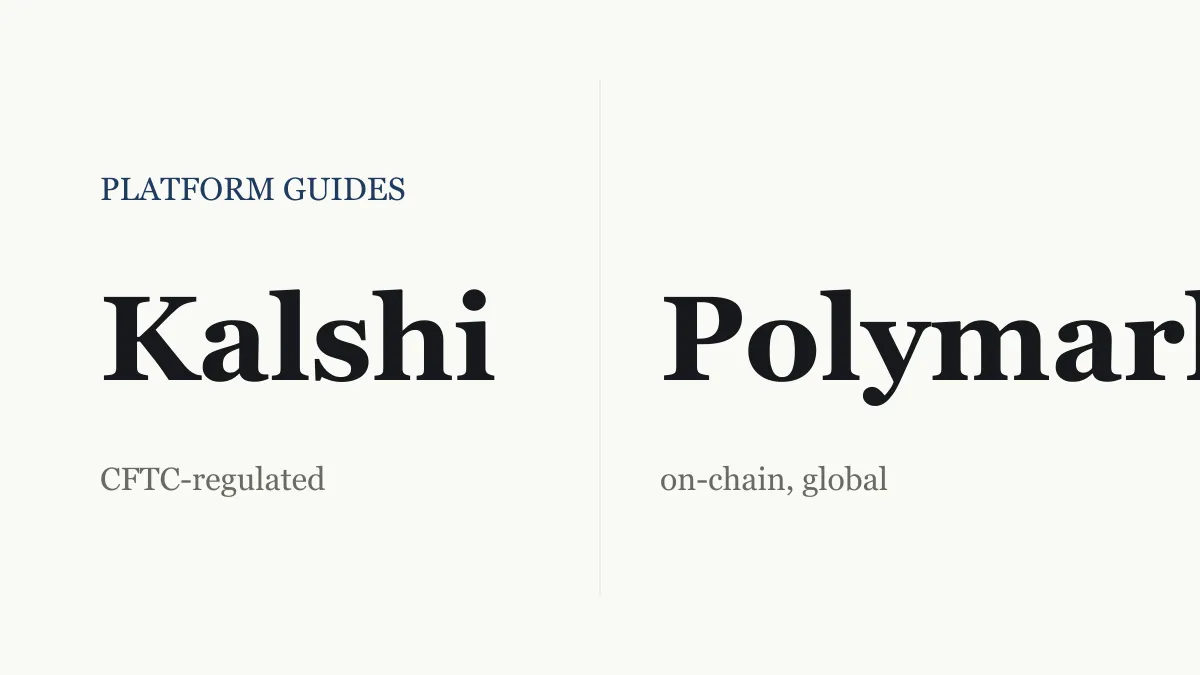
The two largest English-language prediction markets occupy different corners of the same idea. Picking between them is less about which is “better” and more about which is right for the trade you want to make.
At a glance
| Feature | Kalshi | Polymarket |
|---|---|---|
| Jurisdiction | US, CFTC-regulated | On-chain, global |
| Funding | USD bank/wire | USDC on Polygon |
| Resolution | Named regulated sources | UMA optimistic oracle |
| Typical volume | Lower | ~4x higher |
| Available markets | Curated, narrower | Long tail, broader |
When Kalshi makes more sense
- You’re a US resident and need a regulated venue.
- You care about resolution clarity above all — Kalshi cites a specific source for every market.
- The market you want is on Kalshi (election results, economic indicators, weather).
When Polymarket makes more sense
- You want depth — most markets clear faster on Polymarket.
- You’re looking for a long-tail event (a niche sports prop, a mid-tier election).
- You can hold and trade USDC.
The hidden third axis: order book depth
For any market that exists on both venues, check the order book before you trade. The same market can have a 2¢ spread on one platform and a 12¢ spread on the other. That single metric will determine your fill quality more than any feature comparison.
Common questions
Can US residents trade on Polymarket?
No. Polymarket is geofenced from US users and using a VPN to access it violates its terms. US residents who want regulated event-contract exposure should use Kalshi, which is licensed by the CFTC.
Which platform has more markets?
Polymarket lists more markets across a broader long tail (mid-tier elections, niche sports props, crypto markers). Kalshi runs a curated set focused on US elections, economic indicators, and weather, with stricter resolution sourcing.
Which platform has tighter spreads?
It varies by market. Polymarket generally has more depth on high-volume political markets; Kalshi tends to be tighter on US economic-indicator and weather contracts. Always check the order book on the specific market before trading.
How do you fund each platform?
Kalshi accepts USD via bank transfer or wire and is treated like a brokerage account. Polymarket runs on USDC on Polygon — you fund a wallet with USDC and trade on-chain. Tax treatment differs accordingly.
Is one platform safer than the other?
Different risk profiles. Kalshi carries the safeguards of a CFTC-regulated venue (segregated funds, reporting). Polymarket is a smart-contract protocol — counterparty risk is replaced by smart-contract and oracle risk. Neither is "safer" in the abstract; they fail in different ways.