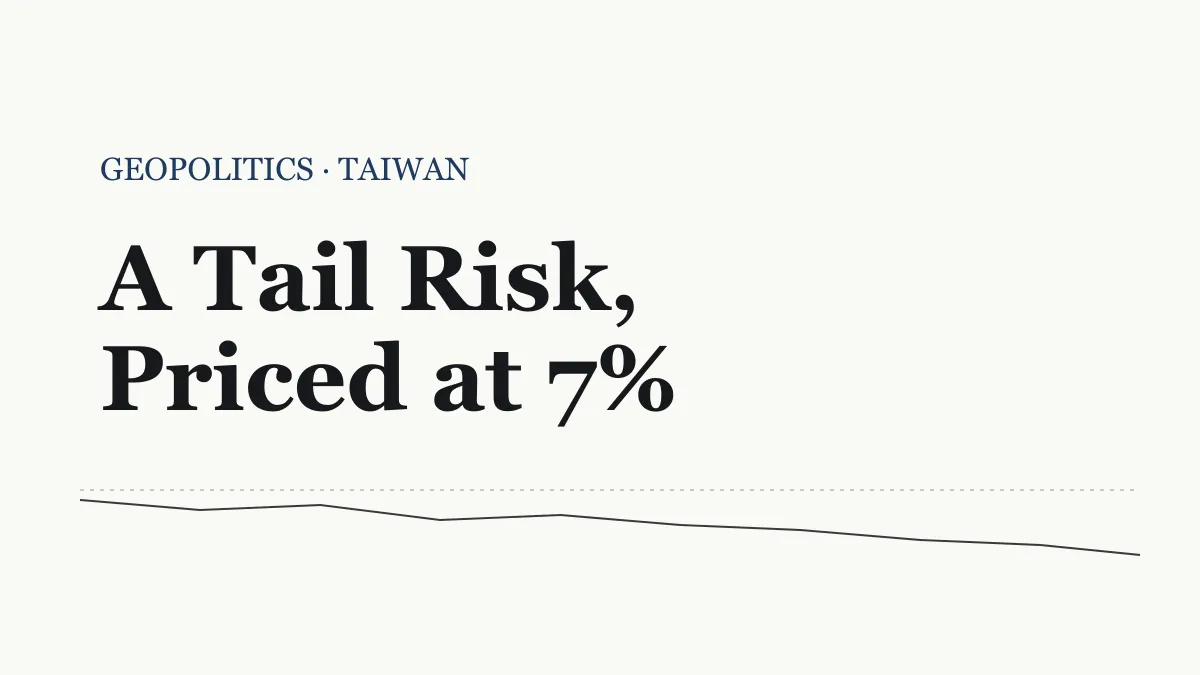
The question of whether China will invade Taiwan is the most consequential tail risk in global capital markets — and one of the few major geopolitical questions with a deep, continuously priced market attached. As of late April 2026, Polymarket traders assign a 7.5% probability that China invades Taiwan by the end of 2026. More than $23 million has cleared on this contract, making it among the highest-volume geopolitical markets ever listed.
A 7.5% price is not “low risk” in the way a coin flip is low risk. Tail outcomes in global markets routinely price in single digits and still warrant serious hedging. But the market signal — and the calendar curve underneath it — is unambiguous: traders do not believe an invasion is imminent.
The current price stack
| Candidate | Implied | Prob. | Δ pp |
|---|---|---|---|
| By June 30, 2026 | | 2% | — |
| By September 30, 2026 | | 7% | — |
| By end of 2026 | | 8% | — |
| By end of 2027 | | 12% | — |
The shape of this curve matters as much as any single price. Traders are pricing roughly a 4× jump from June to year-end and modest extension into 2027. That is consistent with a market that views invasion as a low-probability event whose risk accumulates slowly with time, not a market pricing imminent action.
Why traders price this so low
Three structural reads anchor the consensus.
US intelligence assessments. The March 2026 ODNI Annual Threat Assessment explicitly stated Chinese leaders “do not plan a Taiwan invasion by 2027” and prefer unification through coercion rather than force. That document is a price-resetting input every year it lands; the 2026 version reinforced rather than changed the base case.
No mobilization signals. A serious cross-strait operation requires observable preparation at large scale: amphibious exercise scaling, civilian shipping requisition, reservist call-ups, fuel pre-positioning, and a coordinated People’s Liberation Army (PLA) ramp across services. None of these have been seen at the scale that would precede an invasion of Taiwan. Routine PLA Navy carrier transits and East China Sea patrols continue, alongside China Coast Guard quarantine-style drills near outlying islands, but they do not represent a step change.
Coercion as the active strategy. China’s April 12 announcement of 10 new economic incentives for Taiwan — coming after Kuomintang (KMT) leadership talks — is the clearest signal of Beijing’s preferred approach. Economic integration with selective political pressure is the playbook, not blockade or invasion. This is consistent with Xi Jinping’s long-standing position on Taiwan: unification framed as a generational political project, not a near-term military one.
The military balance Polymarket is implicitly pricing
The 7.5% price embeds a specific read of the military balance across the Taiwan Strait. Three components matter most.
The PLA Navy. China has commissioned the world’s largest navy by hull count, and the PLA Navy has expanded large-scale amphibious capabilities — including Type 075 helicopter docks and an accelerating Type 076 program. But the gap between capability to project force and capability to sustain a contested cross-strait landing under fire remains wide. Anti-ship missile defenses on Taiwan, US Navy carrier strike groups in the Western Pacific, and Japanese Self-Defense Force interoperability all complicate the operational math.
The PLA Air Force and air defense. Air superiority over the Taiwan Strait is the single most contested operational variable. Chinese fifth-generation fighter production has scaled, but US-supplied F-16V upgrades to Taiwan, plus stand-off anti-ship and anti-radiation munitions, raise the cost of any opposed approach. Markets read the air-defense balance as the slowest-moving variable — and as the variable most likely to deter an invasion of Taiwan rather than enable one.
Artificial intelligence and electronic warfare. Both sides have invested heavily in AI-enabled targeting, electronic warfare, and battlefield-management systems. Markets generally treat AI as a destabilizing variable in the abstract, but in the cross-strait case it cuts both ways: AI-enabled Taiwan air defense and US sensor-fusion narrow the surprise-attack window, while Chinese AI accelerates command-and-control. The net effect on the 7.5% price has been near zero over the past year.
For traders building a fuller military picture, the China Coast Guard’s South China Sea posture and the long-standing US support for Taiwan in defense-spending and arms sales each act as cross-checks on the headline contract.
What the market is not saying
The contract resolves on a specific definition of “invasion” — typically a military landing of PLA forces on Taiwanese territory or a declared blockade. It does not resolve on:
- Cyber attacks, however severe.
- Quarantine-style maritime exercises that fall short of a declared blockade.
- Cross-strait skirmishes that do not involve a sustained military operation.
- A “Cuban missile crisis”-style standoff that ends without invasion.
This is important because the most likely escalation paths — gray-zone operations, kinetic incidents around outlying islands, cyber blackouts — could resolve the market “No” while still being historic events. The price is narrow on purpose.
For traders comparing this to the other major geopolitical contract, our Russia-Ukraine ceasefire odds breakdown shows how prediction markets price an active conflict, where Taiwan markets price a latent one.
The catalysts that would move the price
Five signals that have historically moved the Taiwan invasion contract by 2+ percentage points:
- A declared PLA mobilization or unprecedented exercise scale. Anything beyond the routine annual cycle — particularly a multi-theater PLA Navy and PLA Air Force exercise that telegraphs an opposed-landing rehearsal.
- A Taiwan Strait incident with casualties. Even a single fatal incident — naval collision, intercept gone wrong, China Coast Guard escalation — has historically been worth 1–3 points.
- A major break between the United States and China. Embassy closures, ambassadorial recalls, sanctions packages, or a public collapse in working channels move year-end odds.
- A Taiwan domestic political shift. A snap election or a Kuomintang (KMT) -led government would compress the price; a DPP supermajority would expand it. The KMT’s position on Taiwan independence is the single biggest internal political variable for traders.
- A Pacific contingency elsewhere. A Korean Peninsula incident or a Senkaku flare-up in the East China Sea tends to push the Taiwan contract higher even when Taiwan-specific signals are quiet.
Cross-strait dynamics in 2026
Cross-strait dynamics in 2026 reflect a textbook coercion campaign rather than an invasion runway. China is using economic carrots — selective tariff relief, expanded cross-strait travel, agricultural import quotas — paired with calibrated military pressure. PLA aircraft median-line crossings continue at elevated rates; PLA Navy formations conduct longer transits around Taiwan; the China Coast Guard runs quarantine-style boardings near Kinmen and Matsu. The combined effect is to keep Taiwan’s defense costs high without crossing the threshold that would force a US response.
US support for Taiwan, meanwhile, has been broadly stable across administrations. Defense spending packages — including stand-off anti-ship missiles, F-16V upgrades, and air-defense interceptors — continue to flow. The Foreign Military Sales pipeline lengthened in 2025 but did not reverse. Long-standing strategic ambiguity remains the official posture, even as bipartisan congressional support hardens around Taiwan’s defensive needs. None of these inputs has caused traders to materially repress the 7.5% price, because none represents a discontinuity in the underlying balance.
How Polymarket compares to other invasion-of-Taiwan forecasts
The 7.5% market price does not exist in isolation. Three other forecast systems publish comparable probabilities, and the gaps between them are informative.
Metaculus — the largest open forecasting platform — has tracked a community probability of a Chinese invasion of Taiwan by 2030 in the 13–18% range through 2026. That is a longer horizon, so the implied annual rate is similar to Polymarket’s near-term curve. Metaculus pulls toward central-tendency views of academic and analyst contributors; Polymarket pulls toward the views of capital-at-risk traders. Convergence between the two has historically been a stronger signal than either alone.
Expert elicitations — periodic surveys of China-watchers run by think tanks like CSIS, Brookings, and the Council on Foreign Relations — produce probability estimates that have ranged from 5% to 25% for the 2027 window. The wide dispersion reflects how much expert views depend on prior frameworks: deterrence-school analysts cluster low, Taiwan-vulnerability-school analysts cluster high.
The RAND Forecasting Initiative and adjacent academic projects publish structured-question forecasts that decompose the headline question into operational sub-questions: cross-strait shipping disruption, PLA Navy mobilization rate, US carrier deployment patterns. These tend to be more useful for hedging than for prediction, because they let portfolio managers map exposure to specific decision nodes rather than a single binary.
The market price aggregates all of this. When Polymarket diverges meaningfully from the consensus of these other systems — especially in either direction — that gap is the trade.
Scenarios and what they would look like in the price
Three forward scenarios traders are pricing implicitly:
Scenario A — continued coercion (base case, ~80%): PLA Navy and Air Force operational tempo holds at 2025–2026 levels. China Coast Guard quarantine-style drills continue near outlying islands. Cross-strait economic incentives expand. KMT-DPP politics oscillate without external escalation. Polymarket holds in the 5–10% range.
Scenario B — gray-zone escalation (~12%): A serious incident — fatal collision in the Taiwan Strait, contested overflight, anti-ship missile near-miss — but no invasion. Polymarket spikes to 15–20% on the news, then bleeds back over weeks as the underlying balance reasserts. This is the highest-volatility scenario for the market without a “Yes” resolution.
Scenario C — invasion (~7%): A large-scale, multi-domain operation. The market resolves “Yes” but, more importantly, every adjacent contract — Asia-Pacific equity volatility, energy futures, US-China sanctions markets — reprices simultaneously. The 7% figure is not a forecast; it is the market-implied probability mass that traders are willing to bet against at current prices.
These scenarios are not exhaustive. They are calibration anchors — useful for reading whether the market is moving on signal or on noise.
How to use this market
If you are running a portfolio with Asia-Pacific exposure, the Polymarket contract is the cleanest single number to monitor. Daily moves of 50–100 basis points are normal noise; a sustained break above 12% would be the first time in two years that traders priced more than a one-in-eight chance of invasion. That would be a signal worth acting on.
For most readers, the more useful application is reading the price as a sanity check on news cycles. When a single op-ed claims “war is imminent,” the market price is the cheap second opinion. As of late April 2026, that second opinion is firm: not this year, probably not next.
If you are new to reading prediction-market prices, our Polymarket explained primer walks through what a price actually represents — and what it does not.
Common questions
What are the odds China will invade Taiwan in 2026?
Polymarket traders price a 7.5% probability of a Chinese invasion of Taiwan by the end of 2026, with a curve climbing from 2% by June to 7% by September to 7.5% by year-end and 11.5% by end of 2027.
How much money is on this market?
More than $23 million has traded across the Taiwan invasion contracts, making it one of the deepest geopolitical markets ever listed on Polymarket.
What does the market consider an "invasion"?
Resolution typically requires a military landing of PLA forces on Taiwanese territory or a publicly declared blockade. Cyber attacks, gray-zone operations, and quarantine-style exercises generally do not resolve the market "Yes." Always read the specific resolution rule.
Why is the price this low if tensions are high?
Tensions and invasion are different signals. US intelligence has explicitly assessed Beijing prefers coercion over force, no large-scale mobilization signals are visible, and China is currently pursuing economic and political integration rather than military escalation. The market reflects that.
What would push the price higher?
PLA mobilization beyond the routine annual cycle, a Taiwan Strait incident with casualties, a major US-China diplomatic break, a Taiwan domestic political shift, or a Pacific contingency elsewhere have all historically moved the contract by at least 2 percentage points.
Is there a similar market on Kalshi?
Kalshi does not currently list a comparable invasion-resolution contract. For US-residents who want regulated event-contract exposure on geopolitical risk, see our Kalshi vs. Polymarket comparison.